
Play a piano online
Two octaves of a real recorded grand. Touch a key - and if you have ever looked at a keyboard and seen only a wall of white, the next section is the thing nobody tells you.
Or try the simple demo belowThe demo is one board with the basics of how it is played. It is free and needs no install, and it is a fraction of what is in the app.
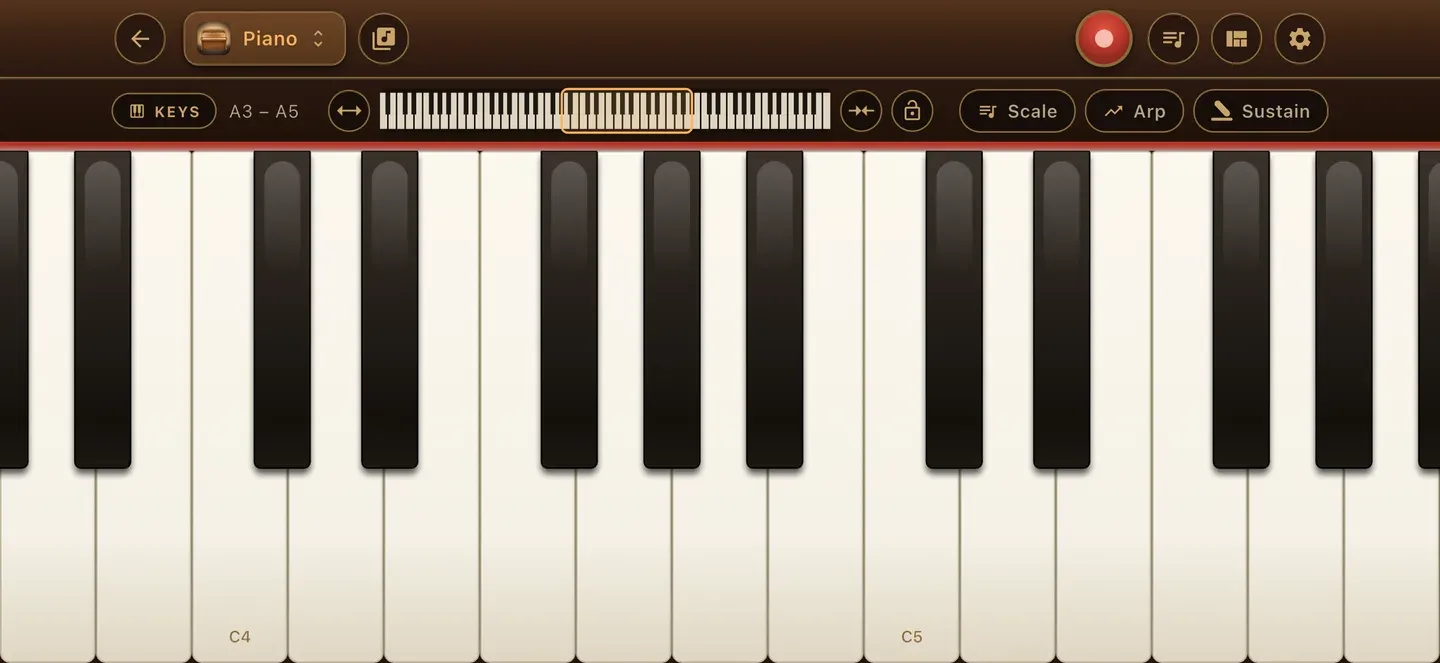
The browser demo
One board, the basics, and the same recordings the app uses. Touch it.
Loading the instrument… Touch a key. Every C is labelled - those are the notes just left of each pair of black keys. Sound could not load.
- Keyboard
- Two octaves, C4 to C6
- Recording
- A real grand, note by note
- Black keys
- Offset where they really sit
- What it teaches
- 100 of the 100 melodies
The keyboard is not a wall - it is a repeating pattern
Look at the black keys. They come in a group of two, then a group of three, then two, then three, forever. That pattern is the entire navigation system of the instrument, and once you see it you can never unsee it.
It is there for a practical reason. Seven of the twelve notes in an octave are white and five are black; if they were spaced evenly you would have no way to know where your hands were without looking. Grouping the black keys two-and-three gives every white key a unique position by touch alone. A pianist finds a note the way you find a light switch in the dark.
Finding C, which is where everything is counted from
C is the white key immediately to the left of any group of two. That is the whole rule. Every C on the keyboard above is labelled, and you can see they all sit in the same place relative to that pair.
From there the rest name themselves, walking up the white keys: C, D, E, F, G, A, B, and back to C. The white key just left of the group of three is F. Those two landmarks - C before the pair, F before the trio - are enough to name any key on any piano you will ever sit at.
Why 88 keys
Seven full octaves plus three extra notes at the bottom: 52 white keys and 36 black ones, from A0 up to C8. The number is not a law of music, it is a manufacturing decision that stuck. Earlier pianos had fewer - 85 was common - and as composers kept writing to the edges of the instrument, builders kept extending it. Steinway settled on 88 in the late 1880s and the rest of the industry followed.
It stopped there for a reason you can hear rather than read: below A0 the strings are so long and slack that the ear stops hearing a clear pitch and starts hearing a rumble, and above C8 the notes turn to glassy ticking. The keyboard ends where usefulness does.
What a piano key actually does
Pressing a key does not "play a note" the way pressing a button plays a recording. It throws a felt hammer at a set of strings and immediately lets it fall away, so the strings are struck and then left to ring. This is why:
- How hard you press changes the tone, not just the volume. A harder strike makes a brighter, harsher sound as well as a louder one - a different sound, not the same sound turned up. It is why a good sampled piano records each note several times at different strengths.
- Once struck, you cannot change the note. No vibrato, no swell. Everything expressive about a piano happens in the instant of the strike and in when you choose to let go.
- Letting go stops it. A damper drops back onto the string. The sustain pedal is simply the mechanism that lifts every damper at once - which is why a piano with the pedal down sounds so much bigger: the strings you are not playing are ringing too, in sympathy.
Sound: Salamander Grand Piano V3 by Alexander Holm (CC-BY 3.0), a real Yamaha C5, rendered through ToneWright's own audio engine.