
Play drums online
Twelve pieces of a real recorded kit, in the positions they occupy around a seated player. Hit something.
Or try the simple demo belowThe demo is one board with the basics of how it is played. It is free and needs no install, and it is a fraction of what is in the app.
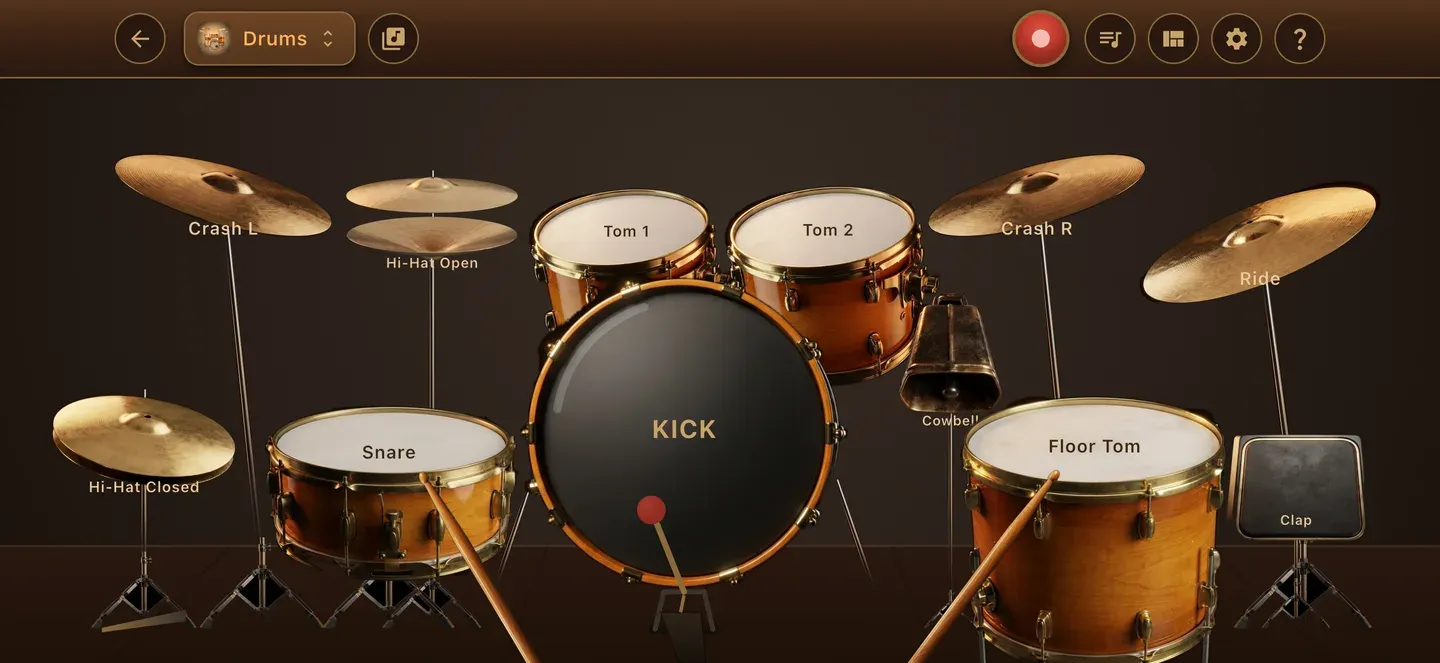
The browser demo
One board, the basics, and the same recordings the app uses. Touch it.
Loading the instrument… Hit a pad. They are where they are on a real kit - hi-hat and snare under the left hand, kick in the middle, ride out to the right. Sound could not load.
- Kit
- Twelve pieces
- Layout
- Where a seated player reaches
- Numbers
- General MIDI notes
- Grooves
- 6 of its own
Three drums do most of the work
A kit looks like a lot of choices. Almost every beat you have ever heard is built from three of them:
- Kick - the low thud, played with a foot pedal. It marks the pulse. In most pop and rock it lands on beats 1 and 3.
- Snare - the sharp crack, from wires stretched under the bottom head that rattle when the drum is struck. It answers the kick, usually on 2 and 4. That call-and-answer is the backbeat.
- Hi-hat - two cymbals facing each other, keeping a steady tick between the other two so the beat has a floor to walk on.
Try it on the kit above: kick, hi-hat, snare, hi-hat, over and over. That is the skeleton of an enormous amount of recorded music.
Why the hi-hat has two pads
Because it is one instrument with two states. A pedal holds the two cymbals together or lets them apart. Closed gives the short tick; open lets them ring and buzz against each other. Players switch between them constantly, and the moment an open hi-hat is snapped shut is one of the most recognisable sounds in music.
A real kit cannot sound both at once - closing the pedal chokes the open one. Good drum software copies that, and so does the ToneWright app.
What the rest are for
- Toms - tuned drums with no snare wires, so they sing a pitch rather than crack. They come high to low across the kit, which is why a drum fill so often sounds like it is falling downstairs: the player is simply moving from left to right.
- Crash cymbals - the exclamation mark. Struck on the edge to mark the start of a section, then usually left ringing.
- Ride cymbal - a crash's opposite. Struck on the body with the tip of the stick for a clear repeating ping; it replaces the hi-hat when a passage needs to open up.
Everything in this kit - 5 metal pieces and the drums between them - sits where it does because of what a seated player can reach without moving: the things you hit constantly are close and low, the things you hit for emphasis are further out and higher.
The numbers underneath
Each pad here sends a General MIDI percussion note - kick is 36, snare 38, closed hi-hat 42 - a numbering that has been standard since 1991 and is why a drum pattern written in one program plays correctly in another. The pads above carry exactly the numbers the ToneWright app sends.
Beats on the kit
Not the melodies at all: 6 grooves of its own, written as grids, because a beat has no pitch and a kit that transposed would turn a kick into a snare.
See the six beats, and play them →
Sound: GeneralUser GS by S. Christian Collins, rendered through ToneWright's own audio engine.