
Play a kalimba online
Seventeen tines in C, laid out the way a real board is: the lowest note in the middle, the scale climbing outward. Touch one.
Or try the simple demo belowThe demo is one board with the basics of how it is played. It is free and needs no install, and it is a fraction of what is in the app.
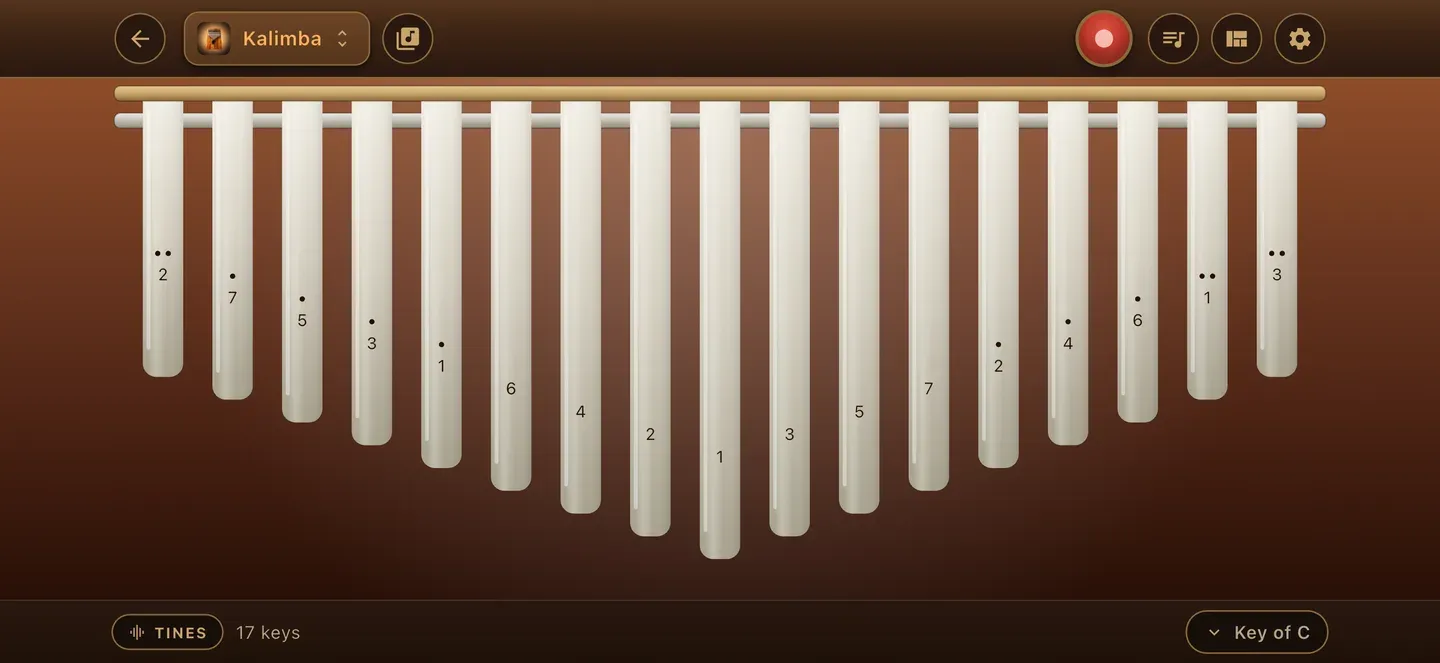
The browser demo
One board, the basics, and the same recordings the app uses. Touch it.
Loading the instrument… Touch a tine. The lowest note is in the middle, which is how a real board is laid out. Sound could not load.
Key of C- Tuning
- C major, diatonic
- Tines
- 17, and a 21-key board
- Range
- C4 to E6
- What it teaches
- 76 of the 100 melodies
These are recordings of a real kalimba, played through the same sound engine as the ToneWright app - the browser and the app are the same instrument. What the browser cannot do is answer your finger instantly. That is what the app is for.
Why the low note is in the middle
Every other keyboard instrument you have met runs low to high, left to right. A kalimba does not. The longest tine - the lowest note - sits in the centre, and the scale steps outward in alternating directions: the second degree just left of centre, the third just right, the fourth further left, and so on to the short tines at both edges.
This is not decoration. The instrument is held in both hands and played with two thumbs, and both thumbs reach the middle most easily. Putting the root there, and letting each hand take alternate degrees of the scale, is what makes a run of notes fall naturally between the thumbs. It also means the interval you play most - a third, one thumb after the other - is a single alternation, which is why simple kalimba arrangements sound fuller than the number of notes suggests.
How to read kalimba tab
Because the tines are not in a line, staff notation is awkward for a kalimba and almost nobody uses it. Kalimba music is written in numbers - the ones printed on the tines above:
- 1 to 7 are the degrees of the scale. On a board in C, 1 is C, 2 is D, 3 is E and so on. The number tells you the tine, not the pitch, so the same tab plays on a board tuned to any key.
- Dots above a number raise it an octave - one dot for the octave above, two for the one above that. On this board the numbers with one dot are the middle range and two dots the highest tines.
- Numbers stacked vertically are played together; numbers side by side are played one after another.
That is the whole system. It is why a kalimba is one of the fastest instruments to start on: there is nothing to decode between the page and the thumb.
How this board is tuned
Seventeen tines, C major, from C 4 up to E 6 - two octaves and a third. It is diatonic: seven notes repeating, with no sharps or flats anywhere on the board.
That single fact decides what a kalimba can play. A tune that needs an accidental cannot be played on it without retuning a tine, which is done by tapping the tine along the bridge with a small hammer - longer for flatter, shorter for sharper. Most players never do it, and instead choose songs that live inside the scale. Folk melodies and lullabies are full of them.
The other common board has 21 tines, which adds four lower notes below the root rather than extending the top.
Where the instrument comes from
The kalimba belongs to a large African family of lamellophones - instruments sounded by plucking tuned tongues of metal or cane - of which the Shona mbira of Zimbabwe is the best known. Those instruments are centuries old, and their tunings and repertoire belong to specific musical traditions rather than to the Western scale.
The instrument sold today as a "kalimba" is more recent and more specific: it was designed in the 1950s by the ethnomusicologist Hugh Tracey, who had spent decades recording music across the continent and founded the International Library of African Music. His workshop, African Musical Instruments, built boards tuned to a Western diatonic scale with the alternating layout described above, so that the sound of the mbira family could be played by musicians outside its tradition. Nearly every 17-key board sold since is a descendant of that design.
It is worth keeping the two apart. A kalimba is not a small mbira; it is a Western-tuned instrument built in the mbira's image, and the music written for each is not interchangeable.
Sound: the "Keylimba" multisample distributed with kalimba-online (MIT), rendered through ToneWright's own audio engine.