
Play a handpan online
A Celtic pan in B: the ding in the middle, nine tone fields climbing around it. Touch anywhere on the steel.
Or try the simple demo belowThe demo is one board with the basics of how it is played. It is free and needs no install, and it is a fraction of what is in the app.
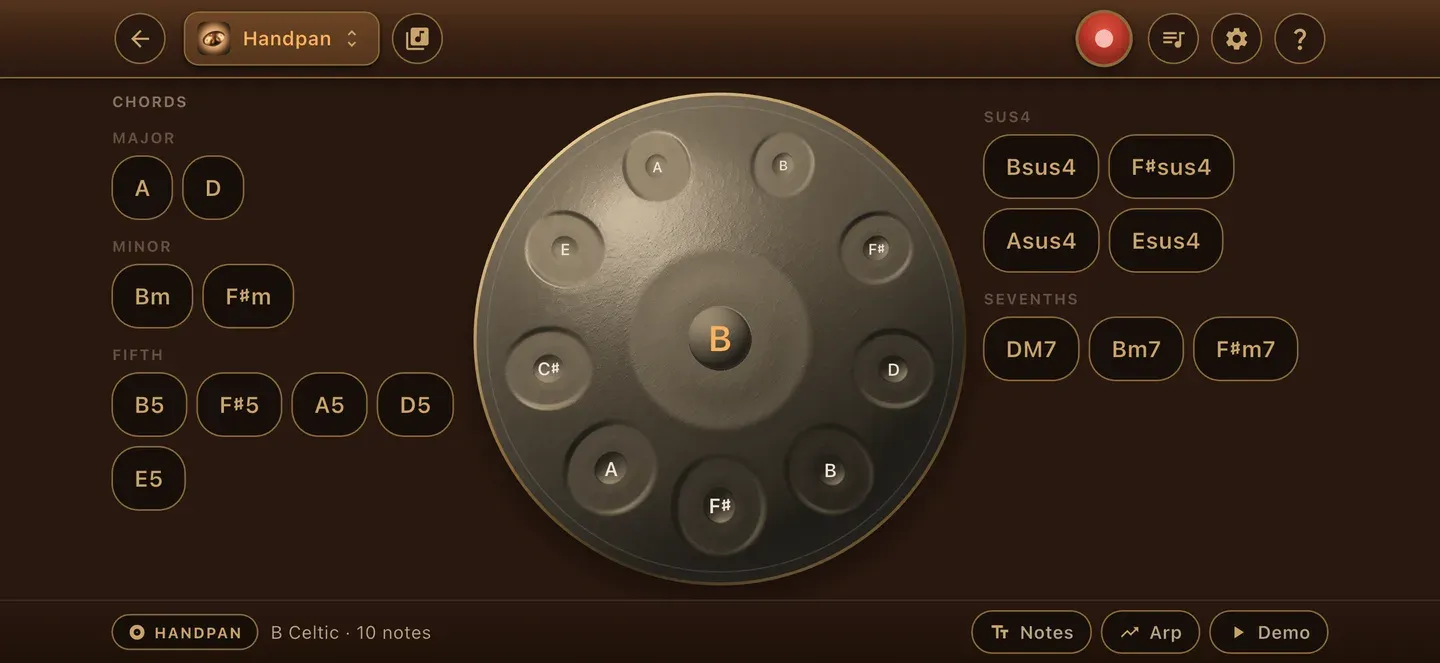
The browser demo
One board, the basics, and the same recordings the app uses. Touch it.
Loading the instrument… Touch a field. The dome in the middle is the ding - the lowest note - and the scale climbs around it, alternating side to side. Sound could not load.
- Scale
- B Celtic
- Fields
- A ding and nine
- Range
- B2 to B4
- What it teaches
- 7 patterns and 13 grooves, 9 melodies
These are recordings of a real Celtic handpan - every field individually, not one note stretched across the disc, because each field is a separate piece of hammered steel and stretching one would not sound like the next. The app has the whole instrument, including the rim.
A handpan can only play one scale - and that is the point
This is the single fact that surprises everyone, and the reason "which handpan scale should I get" is such a common question. A handpan is not tuned like a piano, where every note exists and you choose which ones to use. Each tone field is hammered and tuned individually into the steel, and the instrument has as many notes as it has fields - nine or ten, typically. There is no way to play a note that is not on the shell.
The pan above is a Celtic pan: B · F♯ · A · B · C♯ · D · E · F♯ · A · B. There is no C natural on it, and no F natural, so a tune that needs one simply cannot be played here. What you get in exchange is that nothing you play is wrong. Every note on the shell belongs to the same scale, so any order, any speed, any two notes together - it all agrees. That is why people who have never studied music can sit down with a handpan and sound musical within a minute, and it is also why choosing a scale matters so much: you are choosing the mood of everything you will ever play on that instrument.
The common scales, compared
Below are the three the ToneWright app carries. All three are in B - the pans the app is sampled from - so the difference you hear is the shape of the scale, not its pitch.
| Scale | Ding | Tone fields | Notes |
|---|---|---|---|
| B Celtic | B | F♯ A B C♯ D E F♯ A B | 10 |
| B Arabic | B | F♯ G A♯ B C♯ D F F♯ | 9 |
| B Pygmy | B | D E F♯ G B E F♯ | 8 |
Celtic is a minor scale with the sixth left out - open, wistful, and the most forgiving to improvise on, which is why it is the one most often recommended to beginners. Arabic (a Hijaz colour) puts a wide step between its second and third notes; that gap is the whole character, and it turns the same rolling pattern into something that sounds Middle Eastern. Pygmy is a five-note scale with fewer fields and bigger gaps - sparser, and harder to make busy.
Beyond these there are dozens more in circulation - D Kurd, Amara, Hijaz, Equinox, Sabye and so on. Their names are builders' names rather than a standard, and the same name from two makers can differ. What never differs is the principle: the note list is the instrument.
Ding, tone fields, gu
- The ding is the dome at the centre of the top shell, and it is the lowest note. It is struck with the thumb or the base of the palm and acts as the instrument's root - most playing returns to it.
- The tone fields are the hammered dimples around it, each tuned to one note. Struck near the centre of a field they sing; struck near the edge they are quieter and more percussive.
- The gu is the hole in the bottom shell. It is not a note - it is the port that lets the body resonate, and covering or uncovering it while playing changes the sound the way a hand over a bottle mouth does.
There is a fourth sound that is not a note at all: a slap on the rim, outside the playing face, which is a dry click. Players use it as percussion between notes, and it is the reason a solo handpan piece can have a rhythm section.
Why the fields alternate side to side
Look at the disc again: the lowest field sits at the bottom, then the scale steps right, then left, then further right, working up to the top. It is not decorative. The instrument sits in the player's lap and is played with both hands at once, so consecutive notes have to fall on alternate sides - otherwise a simple ascending run would need one hand to cross the other. The zigzag is what makes the rolling, both-hands sound of handpan playing physically possible.
Where the instrument came from
It is younger than almost anyone assumes. The Hang was built in Bern by Felix Rohner and Sabina Schärer of PANArt, who had spent years working with Caribbean steel pans, and was unveiled in 2000 after a percussionist asked them for a steel instrument that could be played with bare hands rather than sticks. The name is Bernese German for "hand".
"Hang" is a trademark belonging to its makers. As other builders began producing instruments in the same family from around 2007, the community settled on handpan as the generic word. So "hang drum", the term you will still see everywhere, is doubly wrong: it borrows a trademark, and the instrument is not a drum - it is a tuned idiophone whose notes are pitches, not hits.
Sound: "Celtic Handpan" samples by The Sample Shack (WTFPL), one recording per field, rendered through ToneWright's own audio engine.