
Play a guzheng online
Twenty-one strings tuned in D, D2 at the bottom up to D6. Touch one, or run a finger down them all.
Or try the simple demo belowThe demo is one board with the basics of how it is played. It is free and needs no install, and it is a fraction of what is in the app.
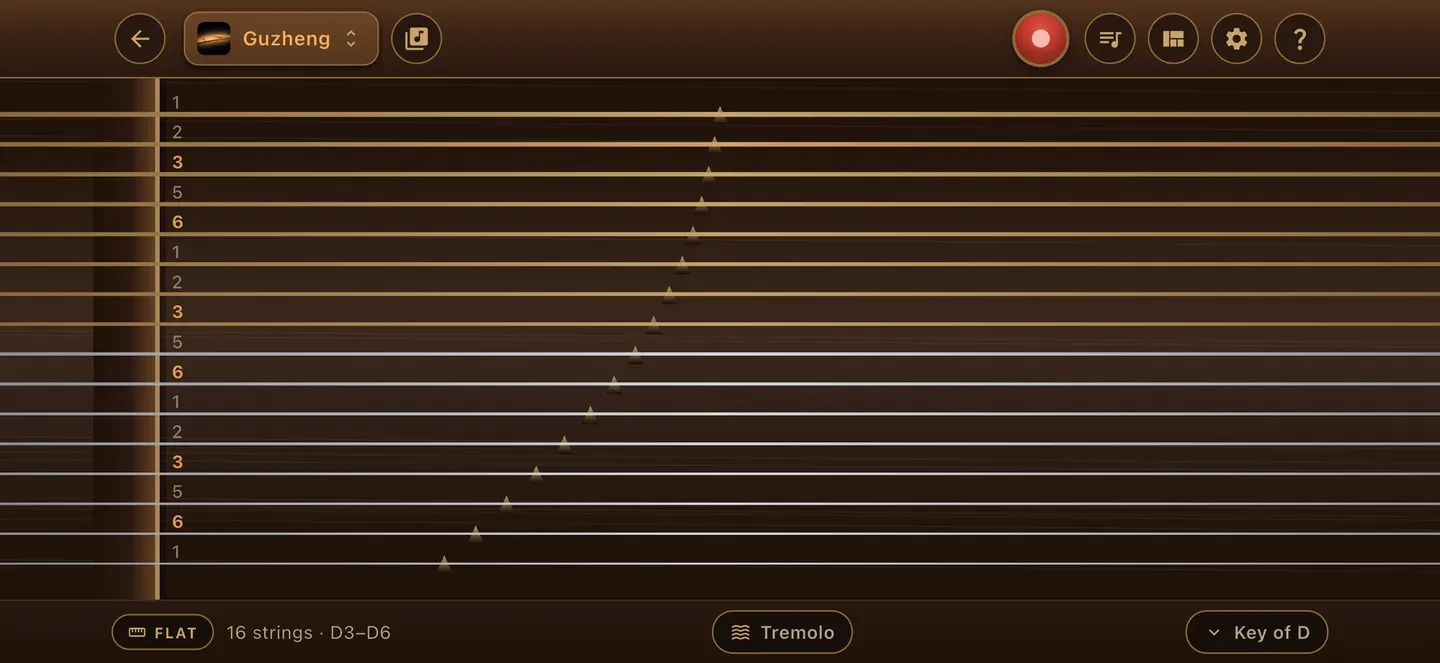
The browser demo
One board, the basics, and the same recordings the app uses. Touch it.
Loading the instrument… Touch a string. There is no fa and no ti anywhere on the instrument - the marked strings are the ones a player presses to bend those notes into existence. Sound could not load.
- Tuning
- D pentatonic
- Strings
- 21, two of them pressed
- Range
- D2 to D6
- What it teaches
- 6 studies, 9 melodies
Recorded from a real zheng and rendered through the same engine the ToneWright app uses. What is missing here is the left hand - the presses and slides that make the instrument sing. The app has those.
Five notes, not seven
Run down the strings and you will hear the pattern repeat every five, not every seven: D E F♯ A B, then the same five an octave higher, four times over. This is a pentatonic tuning - do, re, mi, sol, la - and it means two notes of the familiar seven are simply not on the instrument: fa and ti.
That is not a limitation the way a missing key on a piano would be. It is the reason a guzheng is so hard to play badly: with no fa and no ti, the intervals that clash are absent, so a glissando down the whole instrument - the sound everyone recognises - lands in tune every time.
So how are fa and ti played?
With the left hand, on the other side of the bridge. The right hand plucks; the left hand presses down on the same string in the length between the bridge and the far end, which tightens it and raises the pitch. Press a mi string lightly and it becomes fa. Press a la string harder and it becomes ti. Those two strings are marked on the board above.
This is why the guzheng sounds the way it does. The missing notes arrive by bending into them, not by being struck, so they carry a slide and often a vibrato. A melody that would be plain on a piano acquires ornament automatically, because the instrument cannot produce those two notes any other way. The technique has a name - àn yīn, pressed tone - and learning to land it in tune is most of what a beginner spends their first year on.
The bridges move
Each string sits on its own bridge, and the bridges are not fixed: they stand loose on the soundboard under string tension. Sliding one along the board changes that string's speaking length, and so its pitch. The diagonal you see above is the arc they form - further from the player on the long bass strings, closer on the short treble ones.
Practically, this means a guzheng is retuned by moving furniture rather than by turning pegs. Changing key is a physical job of shifting bridges and checking each string, which is why a player commits to a tuning for a piece rather than modulating within one. D and G are the common ones.
What the numbers mean
The numbers on the left of the board are jianpu - the numbered notation used across Chinese music. 1 2 3 5 6 are do re mi sol la, and you will notice 4 and 7 never appear: those are the fa and ti the tuning does not have. A guzheng score is read in these numbers, with dots above or below to move an octave, so the same score plays in whatever key the instrument is tuned to.
Guzheng, guqin, koto, đàn tranh
They are relatives, and they are constantly confused:
- Guzheng - 21 strings today, one movable bridge per string, played with picks taped to the fingers. Loud, bright, and the one most often heard.
- Guqin - seven strings, no bridges at all; pitch comes from stopping the string against the board. Much quieter and much older, with a repertoire of its own.
- Koto - the Japanese member of the family, usually 13 strings, also with movable bridges. Different tunings and a different repertoire.
- Đàn tranh - the Vietnamese member, usually 16 or 17 strings; the pressing hand is used even more heavily, and ornament is central rather than decorative.
All of them descend from the same long-zither idea. What separates them is the number of strings, whether the bridges move, and how much of the music lives in the pressing hand.
Sound, honestly: these are recordings of a đàn tranh, from the Versilian Community Sample Library (CC0), rendered through ToneWright's own audio engine. No freely redistributable guzheng multisample exists, so the instrument's closest relative stands in - the plucking and the body are near enough that the difference is smaller than the difference between two guzhengs, but it is not the same instrument and we would rather say so.