
Play guitar online
Six strings, tuned E A D G B E like a real guitar. Pick a chord and drag a finger down them - that is a strum.
Or try the simple demo belowThe demo is one board with the basics of how it is played. It is free and needs no install, and it is a fraction of what is in the app.
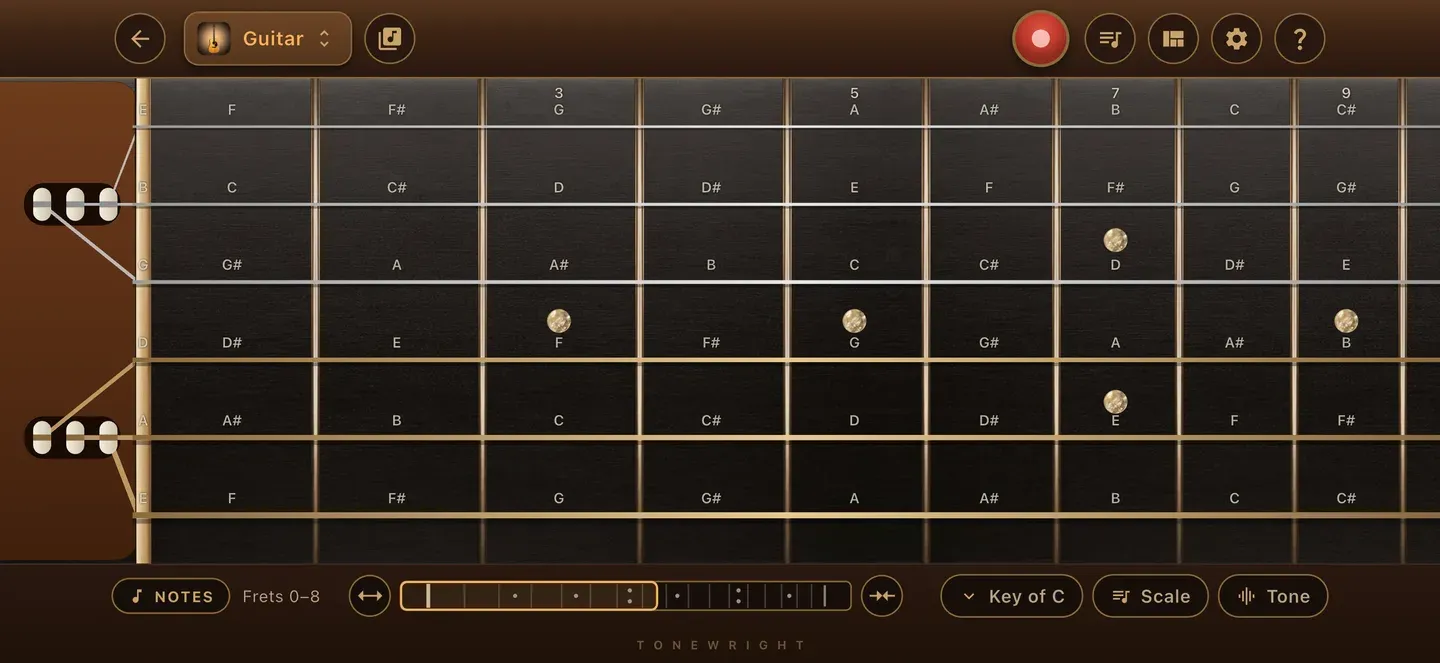
The browser demo
One board, the basics, and the same recordings the app uses. Touch it.
Loading the instrument… Pick a chord, then drag a finger down the strings to strum - or tap them one at a time. Sound could not load.
- Tuning
- E A D G B E
- Chords
- Six open shapes
- Reach
- One position, five frets
- What it teaches
- 100 of the 100 melodies
A chord is a hand, not a list of notes
On a piano a chord is three keys you choose. On a guitar it is a shape: the fretting hand presses particular strings at particular frets, and whatever those six strings then sound is the chord. That is why guitar chords are drawn as grids of dots rather than written as note names.
Switch between the chords above and watch the strings. Nothing about the instrument changes - the same six strings sound different notes because the hand shortened some of them. This is also why guitarists talk about chords being "easy" or "hard": they mean the hand, not the harmony.
Why some strings are crossed out
Choose C or D and one or two strings show a ×. Those strings are not played. In a C chord the lowest string would sound an E under a C chord - a note that belongs to the chord but puts the wrong one at the bottom, so the player mutes it with the side of a finger.
Muting is a real skill, not an omission. A guitarist's fretting hand is doing two jobs at once: pressing the strings that should ring and quietly killing the ones that should not.
The tuning is deliberately uneven
Standard tuning is E A D G B E: four intervals of a fourth, then a third between the G and B strings, then a fourth again. That single irregularity in the middle is the most consequential design decision on the instrument.
Regular tuning in fourths all the way would make scales beautifully symmetrical - and would put common chord shapes out of reach of a human hand. The third between G and B pulls the notes of an ordinary chord into a cluster four fingers can hold. Guitarists pay for it forever after: it is why one shape does not simply slide across all six strings, and why the B string is where beginners' chords go wrong.
Why the same note lives in several places
A piano has exactly one middle C. A guitar has that pitch in as many as four places, on different strings at different frets. They are not identical: a note played high up a thick low string is fatter and darker than the same pitch played open on a thin one.
So choosing where to play something is a musical decision, not just a practical one - a large part of what separates two guitarists playing the same notes.
What a browser cannot give you
Everything above the string: the pick attack, bending a note by pushing the string sideways, sliding into a note, muting with the palm. Those are what make a guitar sound like a guitar rather than a harp, and they need a surface that tracks your finger continuously.
The ToneWright app has them - strum across the strings, bend a held string by dragging, chords under one hand - plus a hundred songs to play along with. It works offline, on a phone or a tablet.
Sound: FreePats Spanish classical guitar (CC0), rendered through ToneWright's own audio engine. The app's own default is a steel-string.