
Play a xylophone online
Ten wooden bars in C major, longest and lowest on the left. Touch one.
Or try the simple demo belowThe demo is one board with the basics of how it is played. It is free and needs no install, and it is a fraction of what is in the app.
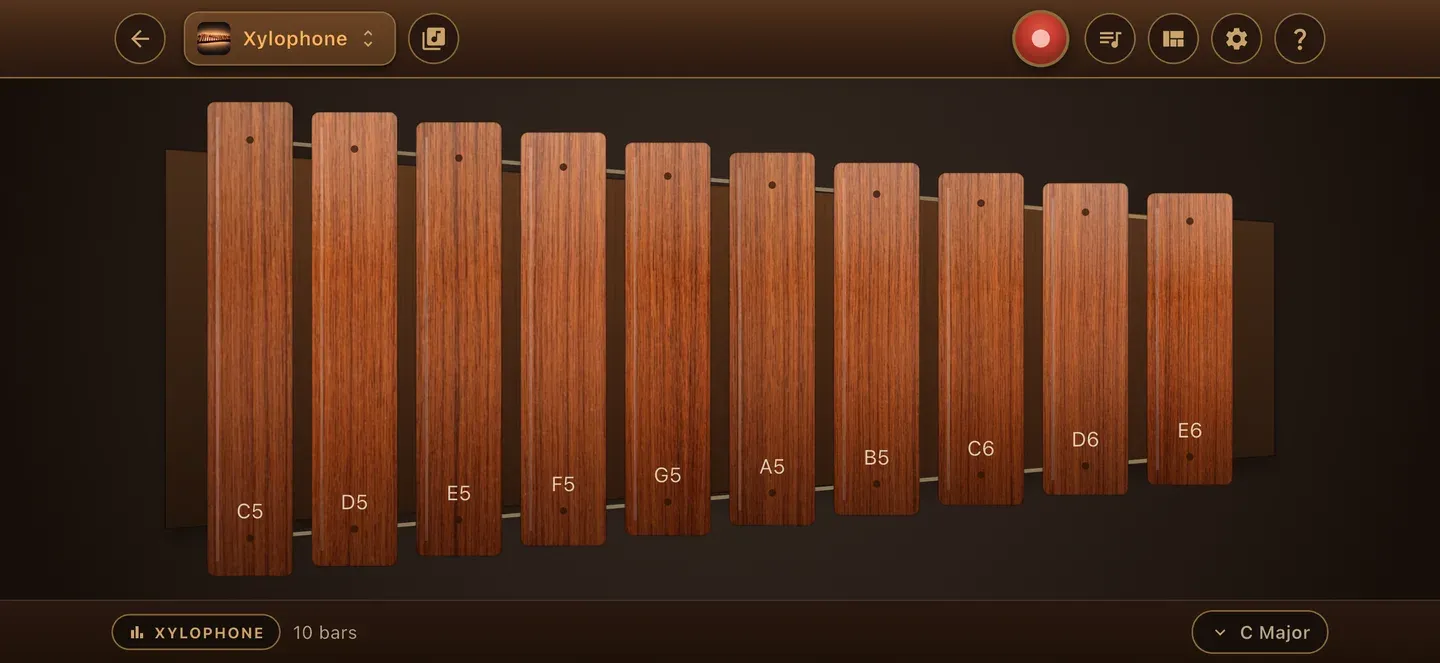
The browser demo
One board, the basics, and the same recordings the app uses. Touch it.
Loading the instrument… Touch a bar. The shorter the wood, the higher the note - that is the whole instrument. Sound could not load.
- Bars
- Ten, in C major
- Range
- C5 to E6
- Sounding
- An octave above written
- What it teaches
- 37 of the 100 melodies
You can see why each note is what it is
Nearly every instrument hides its pitch mechanism. A piano's strings are inside a box; a saxophone's column of air is invisible. A xylophone hides nothing: the shorter the bar, the higher the note, and the bars are laid out in order so the whole scale is visible at a glance.
A shorter bar is stiffer relative to its weight, so it springs back faster when struck, so it vibrates more times a second - and more vibrations a second is exactly what a higher pitch is. Note that the bars are not halved for each octave, only shortened by about a third: the relationship is not linear, which is why a xylophone's silhouette curves rather than slopes.
The two dots on every bar
Each bar hangs on a cord threaded through two points, and those points are not decorative or convenient - they are the nodes, the two places along a vibrating bar that stay still while the rest of it moves. Support a bar at its nodes and it rings; clamp it anywhere else and you kill the note dead.
That is also why you should never hold a bar to stop it. A xylophone has no damper and no way to sustain: the note is struck, it rings briefly, and it stops on its own. Everything a player controls happens in the strike.
Xylophone, marimba, glockenspiel, vibraphone
Four instruments that look alike from a distance and sound nothing alike:
- Xylophone - wooden bars, hard mallets, resonators tuned to an odd harmonic that gives it that bright, dry, woody crack. Short ring. It cuts through an orchestra.
- Marimba - also wooden, but with the bars thinned into a deeper arch and tuned to a different harmonic. Warmer, rounder, much longer sustain, and it goes far lower.
- Glockenspiel - metal bars, tiny, played with hard mallets. Bell-like and piercing; the sound of a music box.
- Vibraphone - metal bars with motor-driven discs spinning inside the resonators, which is where the wobble in its name comes from. It also has a pedal and can sustain, which none of the others can.
It sounds an octave above what it reads
A quirk worth knowing if you ever pick up sheet music for one: the xylophone is a transposing instrument. Its part is written an octave below where it actually sounds, so a player reading C5 produces a pitch that a piano would call C6. The convention exists to keep the part inside the staff instead of floating above it in a cloud of ledger lines.
Sound: Versilian Studios Chamber Orchestra 2 Community Edition (CC0), rendered through ToneWright's own audio engine.