
Play an accordion online
The right-hand keyboard of a piano accordion. Touch a key - then read why this is only half an instrument.
Or try the simple demo belowThe demo is one board with the basics of how it is played. It is free and needs no install, and it is a fraction of what is in the app.
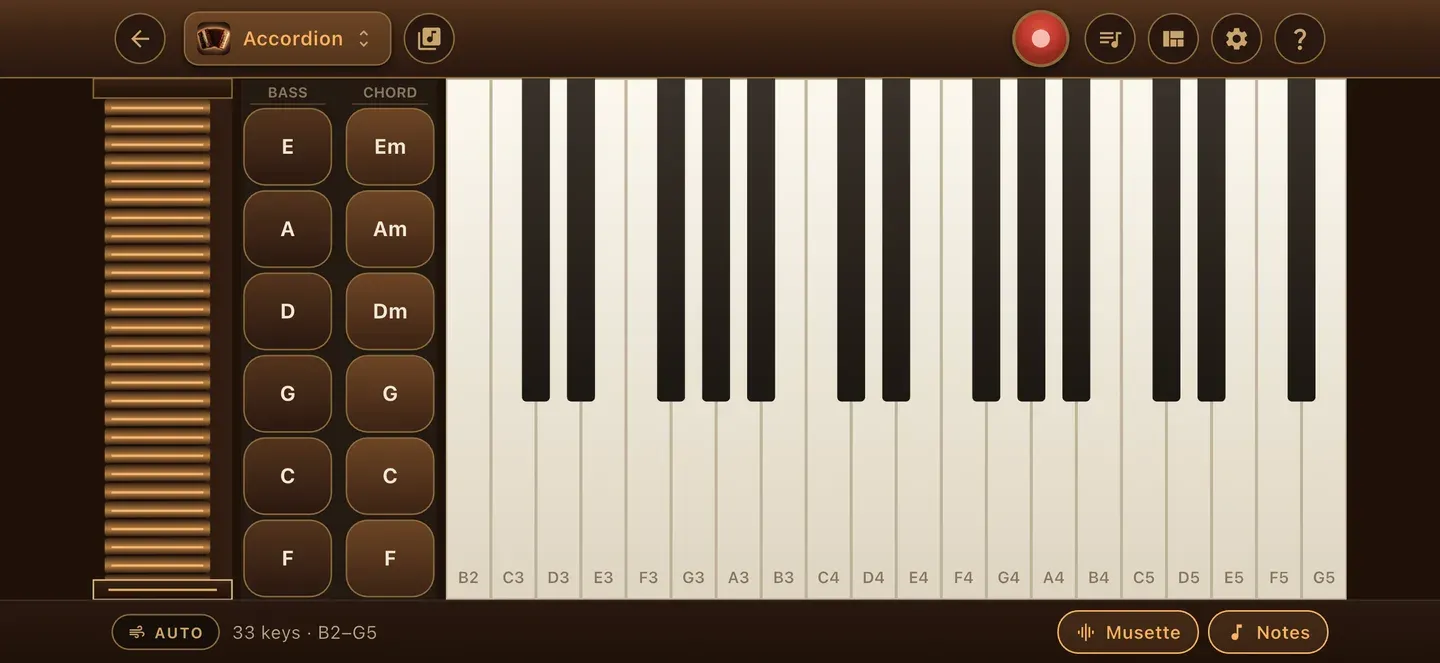
The browser demo
One board, the basics, and the same recordings the app uses. Touch it.
Loading the instrument… Touch a key. This is the right hand only - the bellows and the bass buttons are the other half of the instrument. Sound could not load.
- Keyboard
- Right hand, B2 to G5
- Reeds
- Three registers
- Bellows
- The instrument’s breath
- What it teaches
- 100 of the 100 melodies
The bellows are not a bag for air. They are the breath.
An accordion makes no sound from a key alone. Pressing a key opens a valve; what sounds the note is air moving past a metal reed, and the only thing moving that air is the player pulling and pushing the bellows. Stop the bellows and the instrument goes silent with your finger still down.
That makes the bellows to an accordionist what breath is to a singer. Every swell, every accent, every sudden hush comes from the arm, not the fingers. A hard shove at the moment a chord lands is the accordion's equivalent of hitting a piano key hard - and unlike a piano, it can keep pushing, so the note can grow after it starts.
There is no honest way to give you that with a tap. What you are playing above is a recording of a reed already sounding at a steady pressure. It is the right pitch and the right timbre with the life taken out, and that gap is the instrument.
Reeds, and why one key can sound like three
Inside the box, each note has not one reed but several - typically two to four, tuned in octaves and, crucially, some of them tuned very slightly apart. Switches called registers decide which reeds a key opens.
That deliberate mistuning is the sound people think of as "accordion". Two reeds a few cents apart beat against each other and the note shimmers. Italian builders lean into it heavily - the wet, singing sound of a musette - while a drier tuning is favoured for folk and classical work. Same instrument, same key pressed; different reeds let through.
The buttons on the other side
The left hand plays a grid of buttons, and it is not a second keyboard. On a standard Stradella bass layout, each button in the outer columns sounds a whole chord - one button for C major, another for C minor, another for C seventh - while the two inner columns give single bass notes.
This is why one person with an accordion sounds like a band: the left hand is playing a bass line and a chord accompaniment from single buttons while the right hand plays the tune, and the bellows are shaping all of it at once. The buttons are laid out in a circle of fifths, so the chords a piece needs sit next to each other under the hand.
Piano accordion, button accordion, concertina, bandoneón
- Piano accordion - the one above: right hand on a keyboard, left hand on Stradella bass.
- Chromatic button accordion - same instrument with buttons instead of keys on the right. More notes within reach of a hand, at the cost of a layout that looks like nothing else.
- Diatonic accordions and most concertinas - these are bisonoric: a button gives one note pushing and a different note pulling, like a harmonica. Half the instrument's music comes out of that constraint.
- Bandoneón - the tango instrument, bisonoric, with an infamously irregular button layout that has to be memorised outright.
Sound: FreePats accordion (CC0), rendered through ToneWright's own audio engine.