
Play a violin online
Four strings - G, D, A, E - with the first four places a hand puts a finger. Touch one.
Or try the simple demo belowThe demo is one board with the basics of how it is played. It is free and needs no install, and it is a fraction of what is in the app.
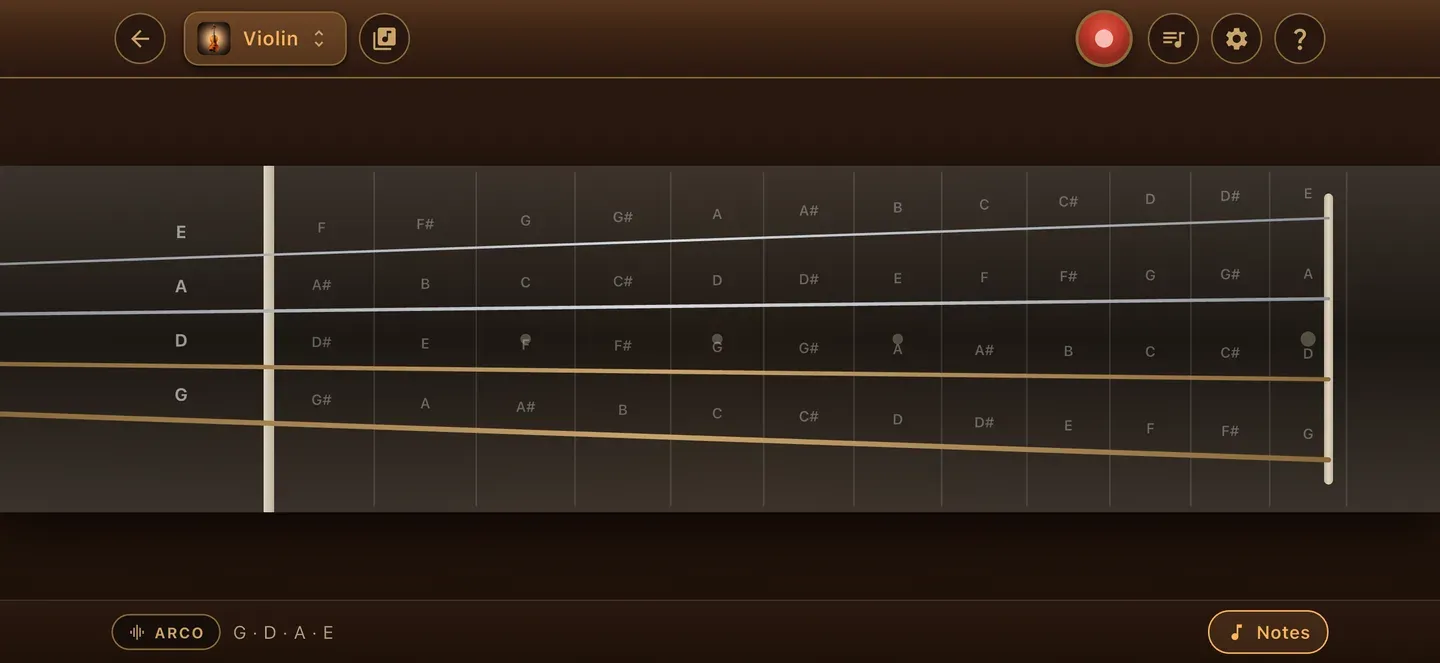
The browser demo
One board, the basics, and the same recordings the app uses. Touch it.
Loading the instrument… Touch a spot on a string. ○ is the open string; 1, 2 and 3 are where the fingers land - there are no frets to tell you, on a real one. Sound could not load.
- Strings
- G D A E, in fifths
- Position
- First, four fingers
- Range
- G3 to E6
- What it teaches
- 100 of the 100 melodies
There are no frets, and that is the whole difficulty
A guitar tells you where the notes are: press behind a fret and the pitch is exact whether or not you meant it. A violin tells you nothing. The fingerboard is a smooth piece of ebony, and the difference between an F and an F♯ is a few millimetres of skin.
This is why a beginner violinist sounds painful while a beginner pianist merely sounds wrong. The pianist plays the correct note badly; the violinist plays a note that does not exist. Learning the instrument is, for the first year or two, mostly learning where the notes are by ear and by the feel of the hand.
What you get in return is everything between the notes. A violinist can slide from one pitch to the next, sit a hair sharp for brightness, or shake the finger to make vibrato. A fretted instrument can only jump.
What the numbers mean
○ is the open string - no finger at all. Then 1, 2 and 3 are the index, middle and ring fingers in first position, the hand placement everyone starts from. The little finger and the higher positions up the neck come later.
Notice that the spacing is uneven: between the open string and finger 1 is a whole tone, and between 2 and 3 only a semitone. A violinist's hand is not a ruler - the gaps change with the key of the music, which is another thing the ear has to do rather than the eye.
The bow is the instrument
The left hand chooses which note. Everything about the note - how it starts, how loud it grows, whether it sings or scratches - comes from the right hand and the bow. Speed, weight and how near the bridge it travels are the three controls, and a player is adjusting all three continuously.
A browser page cannot give you that: a tap is a single instant, and a bow stroke is a continuous act. What you hear above is a recorded bow stroke, not a bow you are drawing. It is the honest limit of playing a string instrument by tapping.
Why a violin, viola and cello are the same instrument
They differ in size and in where they sit, but the family shares one design: four strings tuned in fifths, no frets, played with a bow. Change the size and you change the range - a viola sounds a fifth below a violin, a cello an octave below that - while the fingers do very nearly the same job. A violinist can read a viola part after a week's swearing about the clef.
Sound: Versilian Studios Chamber Orchestra 2 Community Edition (CC0), rendered through ToneWright's own audio engine.